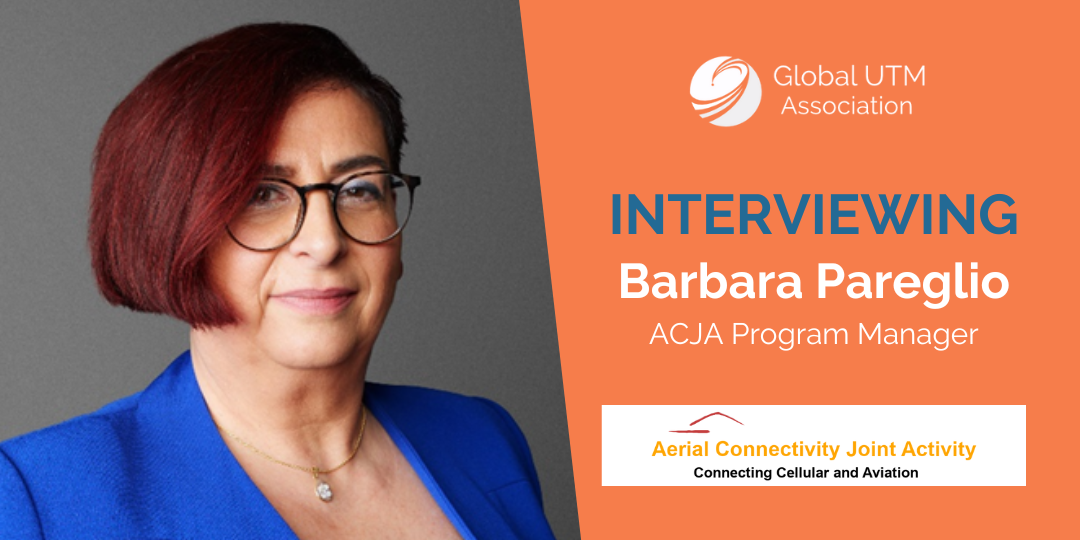
In the framework of strengthening our collaboration with GSMA for the Aerial Connectivity Joint Activity (ACJA), we interviewed Barbara Pareglio, Senior Technical Director – Smart Mobility Lead at GSMA.
Barbara has more than 20 years of experience in telecommunications. Since 2014, she has been the technical lead for several focus areas within the GSMA, such as 5G, IoT, automotive, aviation, and NTN. She also has an extensive background in several standardisations and represents GSMA in 3GPP. Barbara leads the Smart Mobility Community, with the GSMA Drone Interest Group and the Aerial Connectivity Joint Activity in cooperation with the Global UTM Association, to investigate and help the mobile industry to create a trusted solution for commercial unmanned aircraft and beyond.
What motivated the creation of ACJA, and what gap does it aim to fill?
ACJA was established as a collaboration between GUTMA and the GSMA in 2019. Both organizations began exploring the drone ecosystem around the same time: GSMA started looking into the potential of connected drones in 2017, and GUTMA was founded in 2016. Early on, we realized that to enable BVLOS operations at scale, mobile connectivity was the only viable option on the market.
With that in mind, ACJA was created to focus on three main areas:
- The Joint Activity provides a forum for stakeholders from both the aviation and mobile sectors to share their perspectives.
- Each community has its own standards bodies, conferences, and networks, and they are often unfamiliar with one another’s domains. This has resulted in gaps and incompatibilities between standards in the two industries. Therefore, the Joint Activity plays an important role in educating stakeholders about these different standards.
- The Joint Activity is responsible for identifying potential inputs to standards development organizations that could support implementing requirements for using cellular networks in UTM and aviation more broadly.
As a result, ACJA works to elevate the level of understanding across both industries. We have done this through published papers, webinars, and active participation in aviation and mobile conferences. Thanks to the contributions of all ACJA members, we are now seeing progress in several standards bodies, with both UAS and mobile considerations increasingly incorporated.
What are the key technical priorities for ACJA in enabling safe and reliable aerial connectivity, and how does ACJA want to achieve these goals?
The key technical priorities have evolved in parallel with changes in the regulatory landscape. A central question has been how mobile solutions can contribute to the UTM ecosystem and, more broadly, support the scaling of BVLOS operations. At the beginning, much of the focus was on Remote Identification, but over time, this expanded to include connectivity for C2 links as well as data services that help reduce ground risk in support of the SORA process. Significant effort has gone into:
- Developing a practical solution to provide connectivity information throughout the flight path, as well as understanding population density in specific areas
- Understanding the aviation requirements and checking what the mobile community could provide to comply with current regulations.
- Characterizing the C2 link performance and developing a reference method
- Defining an LTE Aerial Profile for the UE (), which is the basis for further upcoming work using 5G.
- Providing an overall landscape of UAS components that are relevant for connectivity, to better understand the overall architecture.
The group is also continuing to provide technical support for work related to the Minimum Operational Performance Standards using mobile communication.
During Harmonized Skies 2025, we discussed how advanced communication networks and digitally managed airspace are enabling faster, safer, and more coordinated drone operations. Why is the collaboration between GUTMA and GSMA important for the future of aviation and telecom?
To achieve true digitization of the skies, multiple forms of connectivity will be required. Existing aviation-specific connectivity solutions are not available everywhere, making it essential to leverage commercially available options, mobile networks being a key one.
Success will depend on strong collaboration between both industries: aviation and telecommunications. This is why the partnership between GUTMA and the GSMA is so important: it ensures an open dialogue around challenges and enables both sides to work together to identify new opportunities.
In the past, ACJA’s work focused on topics such as Cellular Standards Coordination, Data Exchange between MNOs and the UTM ecosystem, supporting aerial services, and documenting the performance of cellular networks in aviation terms. What are the next steps for ACJA?
ACJA will continue its ongoing activities and keep track of evolving standards in both telecommunications and aviation. We will maintain our support for the MOPS, but emerging regulations, such as those related to conspicuity, may open new areas for exploration. Members of GUTMA and the GSMA will work together to identify potential future topics and jointly decide where collaboration can be most valuable.
