
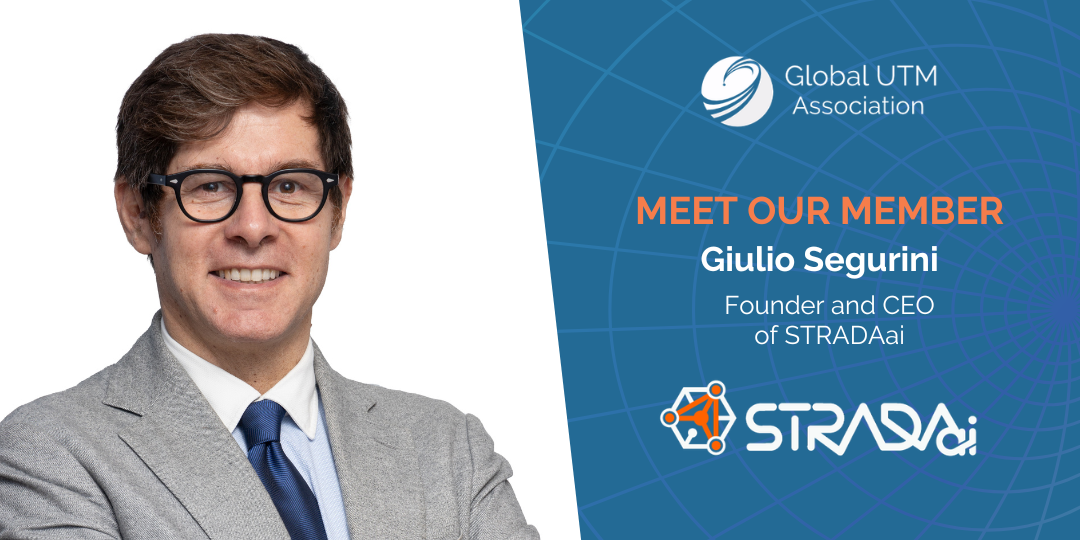
We recently connected with Giulio Segurini, Founder and CEO of STRADAai to discuss its role within our association and the UTM value chain.
U-space is not just traffic management — it is the trust layer of the low-altitude economy. When every flight over a port or a power grid can be authorized, tracked and proven compliant, drones stop being a risk to manage and become infrastructure to rely on.
Giulio Segurini, Founder and CEO of STRADAai
What kind of services/products does your organization provide? What role does your company play within GUTMA?
STRADAai — STRADA Artificial Intelligence S.r.l. — is an Italian company building the digital infrastructure for safe, scalable and, above all, verifiable drone operations. We are in the final stages of certification by ENAC, the Italian Civil Aviation Authority, as a U-space Service Provider under EU Regulations 2021/664, 665 and 666 — positioning STRADAai to become one of the first independent EU USSPs.
Our platform delivers the core U-space services — network identification, geo-awareness, flight authorization and traffic information — integrated with docking stations, counter-UAS sensors and control-room operations. What makes our approach distinctive is the compliance layer we build on top of it. With the EU Critical Entities Resilience (CER) Directive now transposed into law, ports, energy networks and other essential operators face binding resilience obligations. Our USSP infrastructure acts as a certified, independent ledger: every flight over or near a critical asset can be authorized, tracked and documented as third-party-verifiable proof of compliance.
Ports are our flagship environment. In May 2026 we signed an MoU with the Autorità di Sistema Portuale del Mare di Sicilia Occidentale, One of Italy’s most important port authorities based in Palermo, Sicily, making it the first Mediterranean port to adopt dedicated U-space digital infrastructure, with further port authority agreements in progress and initiatives ranging from Drone-as-First-Responder services and drone-services marketplace.
Within GUTMA, we bring the perspective of a Southern European USSP working where U-space regulation meets critical-infrastructure regulation, and we contribute the lessons of our certification journey to the association’s global harmonization work.
From your perspective, what are the current biggest industry challenges?
The first is the gap between regulation and reality. Europe has the most complete UTM regulatory framework in the world, yet designated U-space airspaces remain rare and certified USSPs can still be counted on one hand. Certification is demanding — rightly so — but Member States must match that effort by actually designating airspace; otherwise certified providers have nowhere to operate.
The second is financial sustainability: who pays for U-space? If we wait for drone traffic density alone to justify the investment, we will wait a long time. Our answer is to anchor U-space to the demand that already exists — security and compliance. Critical-infrastructure operators must demonstrate resilience today under the CER Directive and NIS2; U-space services that produce verifiable evidence of safe, authorized operations give them a concrete reason to invest now.
The third is the convergence of UTM and security. Drones are both a tool and a potential threat to the same infrastructure, yet airspace management, counter-UAS, and cybersecurity are still treated as separate worlds with separate authorities and budgets. Operationally, they need to function as one system. Bridging that gap — technically and institutionally — is one of the defining tasks of the coming years.
What are the advantages of engaging and cooperating with other stakeholders within the UTM ecosystem value chain?
No single actor spans the U-space value chain — and none should try. Everything meaningful we have built has been built with others: an exclusive technology partnership with Aloft that brings proven UTM capability into the European regulatory environment; integrations with connectivity, surveillance and 3D-mapping specialists; joint research with universities; consortium projects in Sicily; and territorial ventures with local stakeholders — including a social cooperative of qualified drone pilots — to bring services to municipalities, local police forces and civil protection.
Cooperation also de-risks the market itself. Port authorities, regulators and infrastructure operators do not buy technology; they buy confidence — and confidence grows when they see operators, service providers, authorities and academia aligned around common standards. That is precisely what GUTMA enables: shared templates, comparative readiness data, and a forum where lessons from one implementation — Swiss, Nordic, Belgian or Italian — shorten everyone else’s learning curve. For a company like ours, engaging in this ecosystem is not just marketing: it is how the market gets created.
ABOUT GIULIO SEGURINI
Giulio Segurini is the Founder and CEO of STRADAai. He holds a Master’s degree in Aerospace Engineering and a Master’s in Decision Making Science and brings extensive international business-development experience to the drone sector. He founded STRADAai in Rome in 2023 with the goal of creating the first independent EU U-space Service Provider, leading it through ENAC certification, international technology partnerships, and a strategic focus on ports and critical infrastructure. He is co-authoring a forthcoming white paper on U-space with academic partners.
ABOUT STRADAAI
STRADAai — STRADA Artificial Intelligence S.r.l. — is an innovative start-up headquartered in Rome, founded in February 2023. The name comes from the Latin via strata, a paved road prepared for travel: STRADAai’s mission is to build those roads in the sky, turning low-altitude airspace into safe, digitally managed infrastructure. The company is completing ENAC certification as a U-space Service Provider under EU Regulations 2021/664/665/666 and combines its U-space platform with counter-UAS integration, docking-station and control-room operations, and an advisory practice on Advanced Air Mobility regulation. Its distinctive focus is critical infrastructure: delivering U-space services that generate certified, third-party-verifiable proof of compliance for ports, energy networks and other essential operators under the EU’s CER Directive.
For more information, learn more about STRADAai or connect with Giulio via his LinkedIn page
